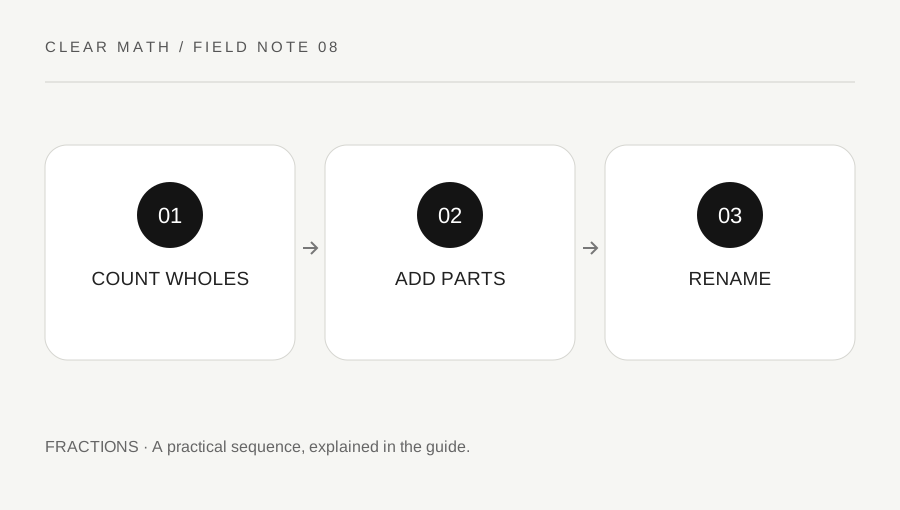
SaveLearning & workAdd and Subtract Fractions Without Losing the MeaningA denominator names the size of a piece. Before combining fractions, make those pieces comparable. A short drawing and a careful equivalent-fraction step make the arithmetic easier to check.4 min read
SaveLearning & workAngles: Use Straight Lines, Intersections and TrianglesAn angle measures turning between rays. Label the diagram and state the relationship before finding a missing value. A printed opening that looks nearly right is not a measurement.4 min read
SaveLearning & workArea and Perimeter: Choose the Quantity Before the FormulaPerimeter measures a boundary. Area measures a surface. A labeled sketch, compatible units and a sensible estimate prevent many errors before any formula is used.4 min read
SaveLearning & workCompare Fractions Using Benchmarks and a Number LineA larger denominator does not automatically mean a larger fraction. Compare equal units, use useful benchmarks and remember that negative numbers reverse some familiar intuitions about size.4 min read
SaveLearning & workCoordinates: Read the Horizontal Value Before the VerticalAn ordered pair describes a position relative to an origin and two axes. Its order, scale and signs matter. Build a consistent plotting routine before connecting points into a graph.3 min read
SaveLearning & workDecimal Place Value and Rounding: Keep the Position ClearA decimal digit gets its value from its position. Read the places first, then use the next place to decide a rounding step. Zeros can preserve meaning even when they do not change the numerical value.4 min read
SaveLearning & workThe Distributive Property: Expand and Factor With MeaningDistribution connects a product with a sum. Use a rectangular model and careful signs to understand expansion, then reverse the same relationship when factoring a common term.4 min read
SaveLearning & workEquivalent Fractions: Change the Name, Keep the ValueEquivalent fractions describe the same number using different equal-sized parts. Learn why multiplying or dividing both parts by the same nonzero factor preserves the value, then use that idea to simplify.4 min read
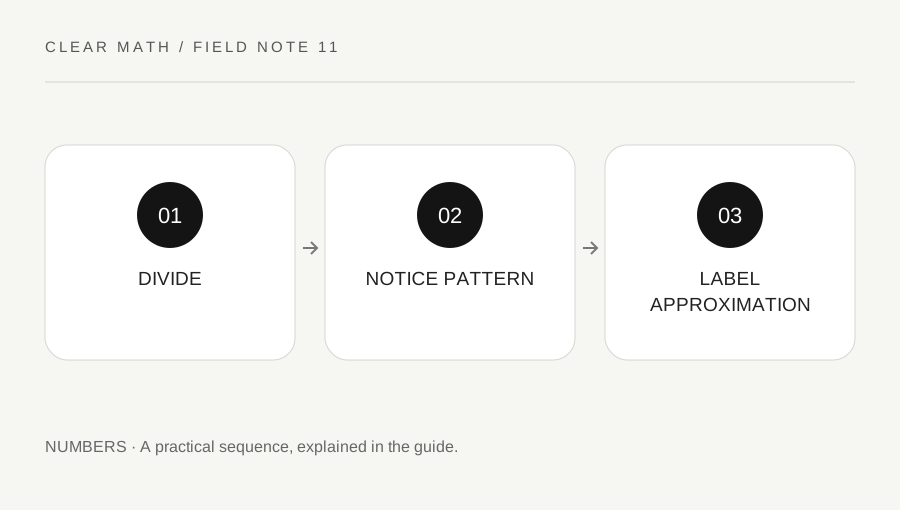
SaveLearning & workFractions and Decimals: Exact Values, Repeats and ApproximationsA fraction and a decimal can name the same number. Some fractions end neatly in decimal form; others repeat. Keep an exact fraction when rounding would hide the relationship you need.4 min read
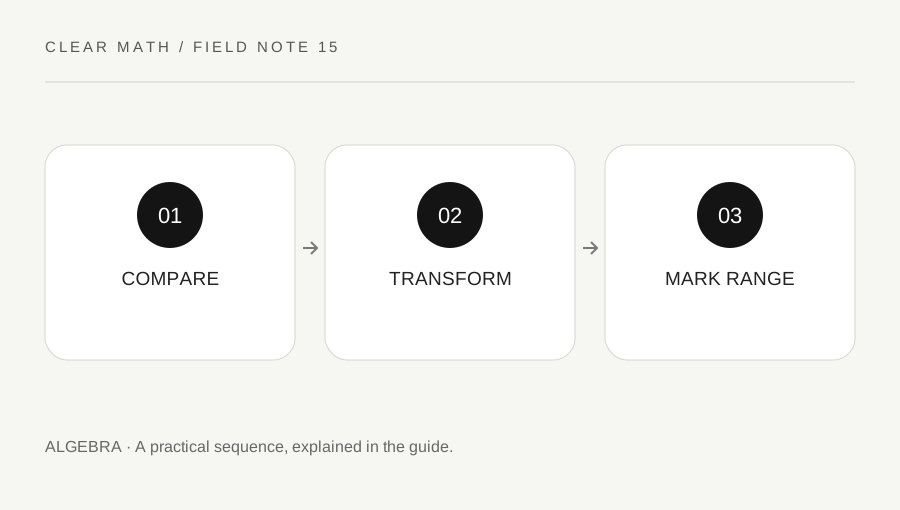
SaveLearning & workSolve a Simple Inequality and Show the BoundaryAn inequality describes a range of possible values. Preserve the comparison while simplifying, and show whether the boundary itself belongs to the answer.3 min read
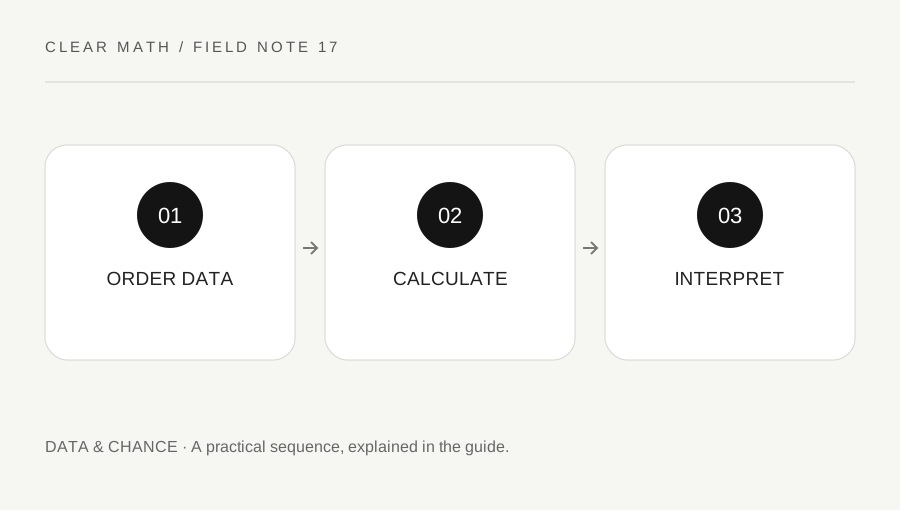
SaveLearning & workMean, Median and Mode: Three Different SummariesAn average helps only when its meaning is clear. Calculate three common summaries, see how they react to an unusual value, and keep the original observations and units available.4 min read
SaveLearning & workMixed Numbers and Improper Fractions: Keep the Whole VisibleA mixed number combines a whole-number part and a proper fraction. Convert by counting equal fractional units, and pay particular attention to grouping when negative signs are involved.4 min read