
Reheat Air-Fried Breaded Foods: Check the Centre, Then the Crust
Breaded leftovers can regain some surface texture in a suitable air fryer, but safe storage and complete reheating come first. This guide concerns previously cooked food with a known safe handling history. A browned crust cannot rescue food that was stored improperly.
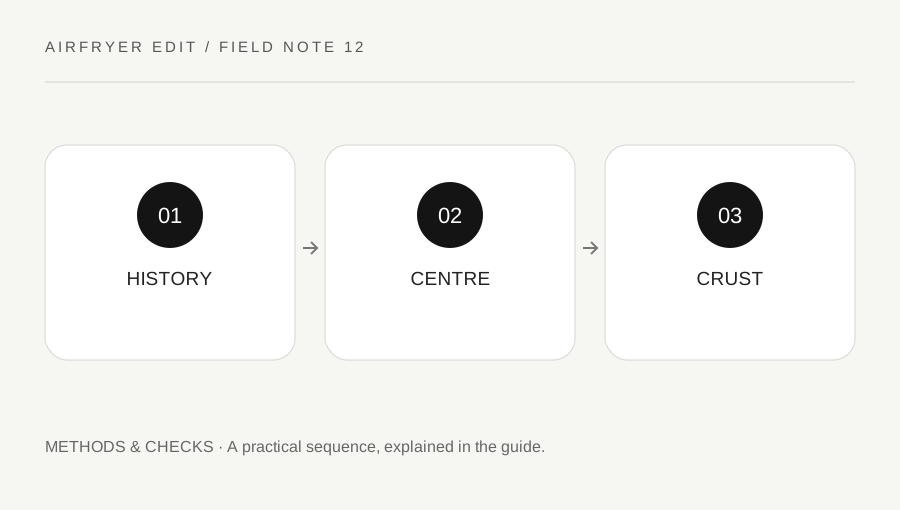
Original explanatory diagram. Examples illustrate a method or decision; they are not claims of personal testing.
Check the leftover before choosing the appliance
Identify when the food was cooked and how it was cooled and stored. Under US guidance, perishable leftovers should be refrigerated promptly, generally within two hours or within one hour above 90°F or 32°C ambient conditions. Keep the refrigerator at 40°F or below and follow current storage-time guidance for the actual food.
If the handling history is uncertain or the permitted storage window has passed, do not taste-test it or rely on reheating to make it safe. Food can be unsafe without an obvious smell or appearance change. The first decision is whether the leftover is appropriate to use, not which setting produces the crispest coating.
Use a supported reheating arrangement
Check the appliance and product guidance for the leftover's shape and ingredients. A thick breaded piece, a filled item and a thin crumb-coated portion can heat differently. Avoid stacking into an unsupported deep pile or adding an unapproved liner. Reheat only the amount you intend to serve promptly where practical.
Use clean utensils and a clean serving plate. Previously cooked food still needs protection from raw-food surfaces. If the air fryer is not suitable for the item's depth or filling, choose another appropriate supported method. A texture preference does not justify an unreliable centre-heating process.
Verify reheating independently of colour
FoodSafety.gov lists 165°F or 74°C for leftovers. Use an appropriate food thermometer and check representative thick locations without touching the hot basket. Follow any product-specific standing or checking instruction as well. Surface browning can occur before the centre is ready.
If the coating darkens too quickly, stop guessing and review the supported method. Do not serve an underheated centre simply because the outside looks done. Nor should you keep scorching the exterior in the hope that time alone will prove the centre. Choose a suitable method that can meet the food-safety endpoint throughout the relevant portion.
Serve and record a realistic result
Once the food has met its required endpoint, serve using clean handling and the intended sauce or side arrangement. Describe texture honestly: reheating may not recreate the exact original crust. A small household note can record the supported load, piece size and checks from an actual session, without pretending it is a universal tested chart.
For a practical example, a safely stored thick breaded portion needs a centre check even when its crumb coating becomes crisp quickly. If the chosen model and arrangement cannot reheat it appropriately, use another supported method. Record storage history and centre-temperature checks separately from the coating’s texture.
Keep storage history attached to the reheating note
A useful reheating record begins before the appliance setting: original cooking date, prompt cooling method, storage temperature and the portion selected for service. Keep any relevant product directions with it. If one part of that history is unknown, do not create a reassuring note by filling in an assumed value.
For a genuine repeat, record the leftover's thickness and the supported arrangement along with the centre check. Surface texture can be described separately as crisp, softened or uneven, without implying a safety conclusion. Do not use repeated heating and cooling as a casual texture experiment. Choose an appropriate portion and handle the remainder according to current official guidance. Use the actual food’s current storage guidance when planning how long to retain the remaining portions. A crisp coating does not demonstrate safe storage or heating.
Questions that come up
Can reheating fix food left out too long?
Do not rely on it. Improper holding or storage can create risks that later heating does not reliably remove. Follow official guidance and discard uncertain food where appropriate.
Does a crisp crust mean the centre is reheated?
No. Check the appropriate internal endpoint in representative thick locations with a suitable thermometer.
Will leftovers taste exactly like the first cooking?
Not necessarily. Texture can change during storage and reheating. Describe real observations honestly and prioritize a suitable safe process over a promise of identical crispness.
References & scope
Background references checked on 18 October 2026. Worked examples and diagrams are original teaching material.